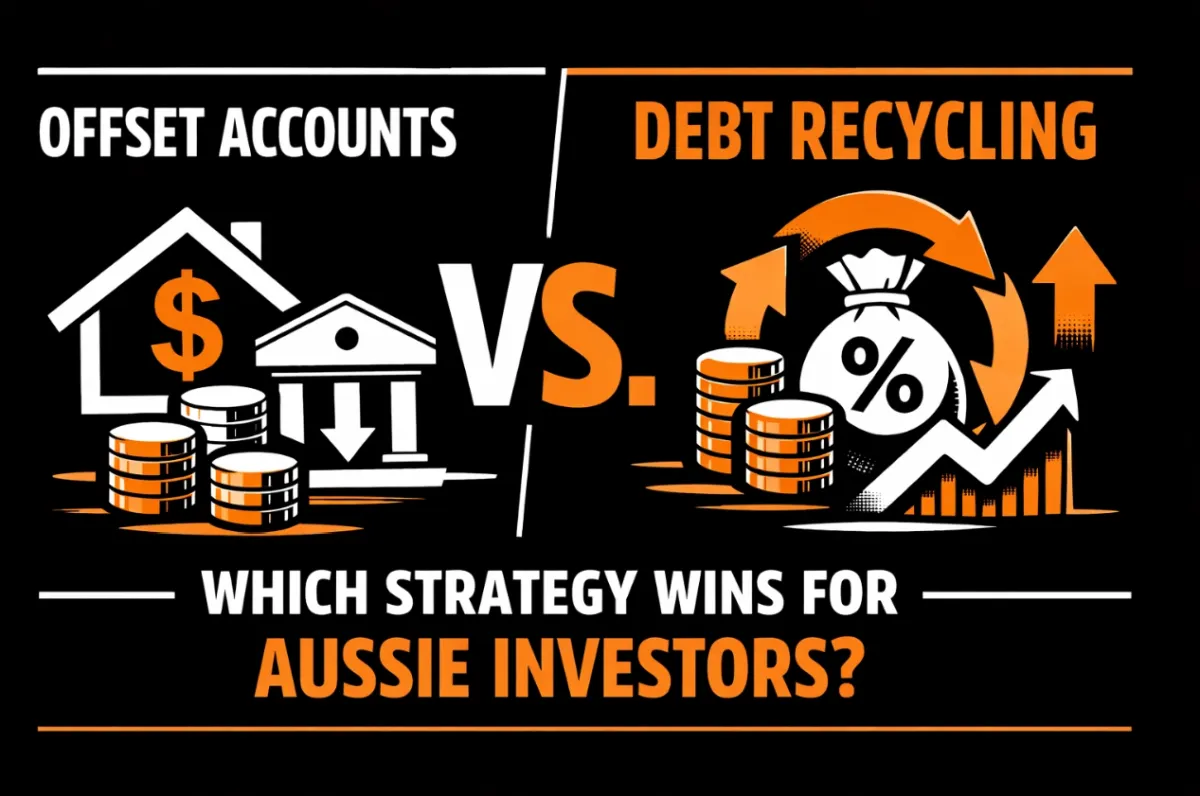
Offset Accounts vs. Debt Recycling: Which Strategy Wins for Aussie Investors?
Offset Accounts vs. Debt Recycling: Which Strategy Wins for Aussie Investors?
![[HERO] Offset Accounts vs. Debt Recycling: Which Strategy Wins for Aussie Investors?](https://cdn.marblism.com/U66zmNYz5u0.webp "[HERO] Offset Accounts vs. Debt Recycling: Which Strategy Wins for Aussie Investors?")
Most Aussie homeowners are playing a losing game. They’ve been told that parking their hard-earned cash in an offset account is the ultimate "safe" move.
It feels good, right? You see your interest payments drop. You feel like you’re winning against the bank. But here’s the cold, hard truth: While you’re "saving" 6% in interest, inflation is quietly devouring your purchasing power, and your debt remains a "non-deductible" weight around your neck.
If you want to move from being a homeowner to a wealthy investor, you need to understand debt recycling.
At Franked Stacker, we don't do "safe" if safe means staying broke. We do efficient. We do tax-effective. We build wealth.
Let’s break down why the offset account is often a trap and how debt recycling uses Aussie property equity to turn the tables on the taxman.
The Offset Account: The "Safe" Trap
An offset account is essentially a high-interest savings account that doesn't pay you interest, it just stops the bank from charging you interest on an equal portion of your home loan.
The Pros:
Instant access to cash.
Zero risk.
Simplicity.
The Reality Check:
Inflation in 2026 isn't playing games. If you have $100,000 sitting in an offset, that $100k buys significantly less today than it did two years ago. Meanwhile, the interest you "save" is on non-deductible debt. The ATO doesn't care about your home loan interest. You’re paying that with after-tax dollars.
Every dollar sitting in your offset is a dollar that isn't working. It’s lazy capital.

Debt Recycling: Turning Bad Debt into Good Debt
Debt recycling is the process of taking the equity in your home, paying down your non-deductible (bad) debt, and immediately redrawing it to invest in income-producing assets.
When you do this, the interest on that redrawn portion becomes tax-deductible.
How it works in 60 seconds:
Pay Down: You take $50,000 from your savings (or offset) and pay it into your home loan.
Split: Your bank splits that $50k into a separate loan account.
Redraw: You redraw that $50k specifically to buy an investment (like an ETF or LIC).
Deduct: Because the purpose of the loan is now "to produce income," the interest on that $50k is now a tax deduction.
The Result: Your total debt stays the same, but your tax bill drops. You’ve just forced the government to subsidize your mortgage.
The Math: Offset vs. Debt Recycling (The Receipts)
Let’s look at a real-world scenario for a high-income earner in the 45% tax bracket.
Scenario A (Offset): You have $100,000 in an offset account against a 6% mortgage. You save $6,000 in interest annually. Total benefit: $6,000.
Scenario B (Debt Recycling): You recycle that $100,000 into a diversified ETF portfolio (yielding 4% dividends + 5% growth).
Interest Saved: $0 (because you spent the cash).
Tax Deduction: $6,000 in interest costs @ 45% back = $2,700 tax refund.
Dividend Income: $4,000 (potentially franked).
Capital Growth: $5,000.
Total Benefit: $11,700.
By recycling, you didn't just save interest, you built a $100,000 asset base that grows over time. That’s how you start building wealth in Australia.
The Franked Stacker Strategy: ETFs, LICs, and Hard Assets
We don’t just stop at debt recycling. We stack.
The goal isn't just to have a tax deduction; it's to create a cash-flow engine. We use Aussie property equity to buy income-producing assets like ETFs or Listed Investment Companies (LICs).
Why? Because they pay dividends.
The Stacker Flow:
Dividends from your ETFs hit your bank account.
Tax Refunds from your deductible interest hit your bank account.
Action: You take that "new" money and use it to pay down more of the non-deductible home loan.
Repeat: Redraw and buy more assets.
Once your cash-flow engine is humming, you move to the next level: Stacking Hard Assets.
This is the chain. Every time. No confusion. No detours:
Home Equity → Debt Recycling → Cash Flow Assets (Dividend ETFs/LICs) → Hard Assets (₿ Bitcoin, 🪙 Silver, 🥇 Gold)
Why this order matters:
Dividend ETFs/LICs: Your cash-flow engine (yield + franking + tax efficiency).
Hard Assets (₿🪙🥇): Your end-game stack (scarcity + long-term purchasing power + zero counterparty risk when held properly).
ETFs/LICs create the cash flow. Cash flow buys hard assets. That’s the point.
Why Most People Are Too Scared to Win
The biggest hurdle isn't the math, it's the mindset.
Aussies are conditioned to fear debt. But all debt is not created equal.
Mortgage debt is a ball and chain.
Investment debt is a ladder.
If you are sitting on $200k+ of equity in your home and it's just "sitting there," you are losing the war against inflation. You are essentially giving the bank a free ride while you work 40+ hours a week to pay off a non-deductible loan.
Stop being a tenant to your own bank.
No-BS FAQ: Addressing the Objections
Is debt recycling risky?
Yes, if you buy garbage assets. No, if you buy diversified, income-producing assets and have a long-term horizon.
Do I need a huge salary?
No. You need equity and a stable income to service the loan. The higher your tax bracket, the better the strategy works.
Can I still access my money?
Yes. You are selling assets instead of withdrawing from an offset. It takes 2 days instead of 2 seconds. Plan accordingly.
Does this work with Bitcoin?
Directly? No. The ATO requires the investment to "produce income" for the interest to be deductible. Bitcoin doesn't pay a dividend. This is why we buy income-producing assets first, then use the income to buy Bitcoin.
How long does it take to set up?
Setup takes about 15-30 mins with your broker and bank once the structure is understood.
Are You Ready to Stop Treading Water?
The difference between an "offset saver" and a "debt recycler" over 10 years is often measured in hundreds of thousands of dollars.
If you have a home loan and you aren't looking at your equity as a tool for growth, you’re leaving your future to chance. The "safe" path is the riskiest move you can make in an era of high inflation and rising costs.
Take Action:
Check your equity. How much is sitting idle?
Set up the chain. Home Equity → Debt Recycling → Dividend ETFs/LICs → Hard Assets (₿🪙🥇).
Track it. Receipts. Cash flow. Progress.
→ See the Franked Stacker Offer

Final Word from Jason (CEO)
Look, I get it. The offset account feels like a warm blanket. But out here in the real world, the wind is blowing, and that blanket is full of holes. Debt recycling is the coat of armor you need to actually build a portfolio that matters.
Stop saving pennies while you lose dollars. Start stacking.
Disclaimer: Franked Stacker provides financial education and investment strategy information. We are not financial advisors. This content is for educational purposes only and does not constitute personal financial advice. Always consult with a qualified professional (Accountant/Financial Planner) before making major financial decisions, especially regarding tax-deductible debt and Aussie property equity.


