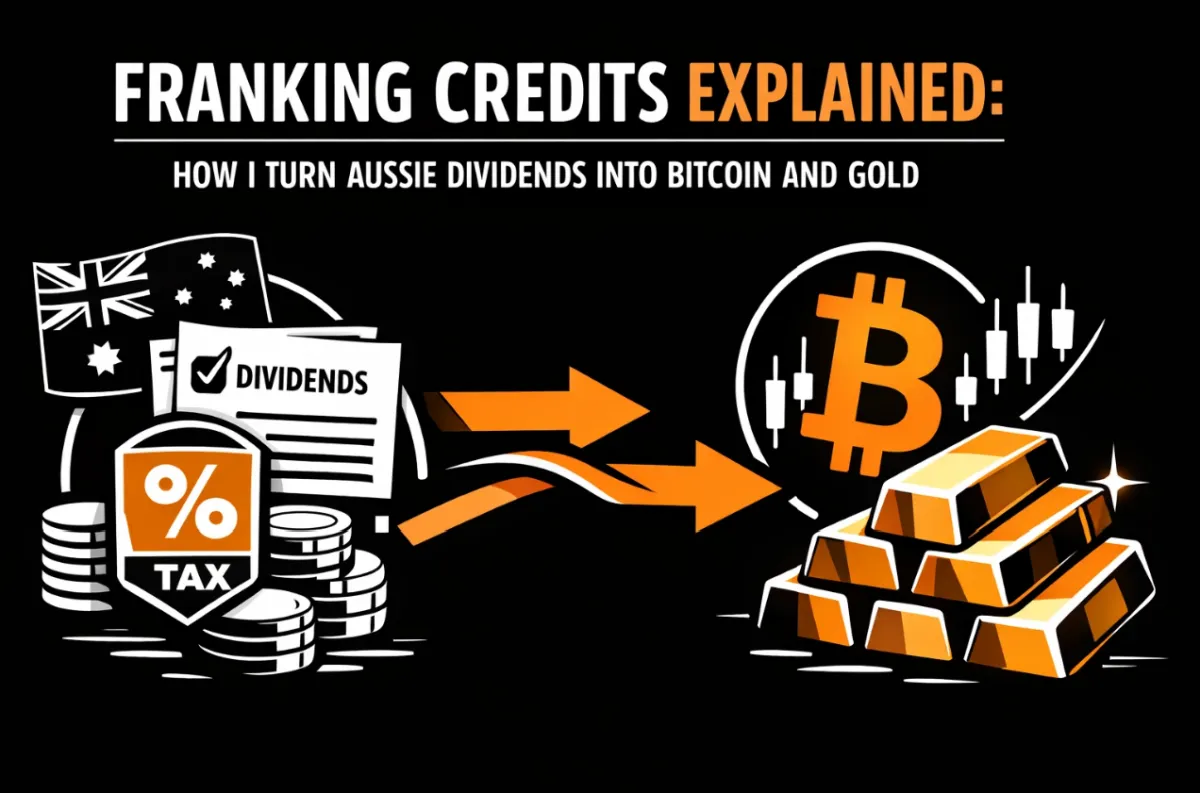
Franking Credits Explained: How I Turn Aussie Dividends into Bitcoin and Gold
![[HERO] Franking Credits Explained: How I Turn Aussie Dividends into Bitcoin and Gold](https://cdn.marblism.com/JGJn-tybera.webp "[HERO] Franking Credits Explained: How I Turn Aussie Dividends into Bitcoin and Gold")
This is educational only and not financial advice. Leverage increases risk and is not suitable for everyone.
Most Australian investors focus on one thing: the capital growth of their house or their share portfolio. They watch the numbers go up on a screen and feel wealthier. But for me, wealth isn’t just a number on a bank statement. It is about building a machine that produces cash flow I can use to buy assets that the government cannot print.
My strategy follows a specific sequence: Home equity → Dividend engine → Hard assets.
The "Dividend Engine" part of that equation is where many Aussies get confused. Specifically, when it comes to franking credits. I see them as a secret weapon in my portfolio. They are the reason I can fuel my Bitcoin and gold stacking faster than if I were just saving from my salary.
In this post, I will break down exactly what franking credits are and how I use them to bridge the "Inflation Gap" by moving paper profits into hard money.
The Foundation: Home Equity to Dividend Engine
Before I explain the tax credits, you need to understand where the money comes from. I don’t just wait until I have spare cash to invest. I use debt recycling.
I take the equity in my home and turn non-deductible mortgage debt into deductible investment debt. This capital goes straight into my dividend engine, primarily Aussie LICs (Listed Investment Companies) and ETFs that pay high, fully franked dividends.
Why Aussie shares? Because of the unique way our tax system handles corporate profits. This is where franking credits come into play.

Franking Credits Explained Simply
When an Australian company like BHP or CBA makes a profit, they have already paid 30% company tax to the ATO. When they decide to share those profits with me as a shareholder, the government realizes that taxing that money again at my personal income tax rate would be "double taxation."
To prevent this, the company attaches a "franking credit" to the dividend. Think of this credit as a receipt from the company saying, "We already paid the tax on this money for Jason."
How the Math Works for Me
Let’s look at a simple example. If a company pays me a "fully franked" dividend of $70, they have already paid $30 in tax on my behalf (assuming a 30% corporate tax rate).
When it comes time to do my tax return:
I report the $70 cash I received.
I also report the $30 franking credit.
My "taxable income" is actually $100 (the "grossed-up" dividend).
The magic happens next. The $30 franking credit is applied as a tax offset against my total tax bill. If my personal tax rate is 30%, I owe nothing extra. If my tax rate is lower than 30%, which can happen if I have structured my debt recycling correctly, the ATO actually pays me that $30 back in cash.
This essentially means I am receiving the full pre-tax profit of the company. In almost any other country, the government takes a huge bite out of those dividends before they hit your pocket. In Australia, we have a unique advantage to build a massive cash flow engine.
The Inflation Gap: Why I Don't Reinvest Everything
A lot of traditional advisors will tell you to "set and forget" and turn on a Dividend Reinvestment Plan (DRP). While that builds the engine bigger, it keeps all my wealth inside the financial system, the "paper" world.
I am worried about the Inflation Gap. The RBA continues to tinker with interest rates, and the cost of everything from groceries to insurance is skyrocketing. Cash is losing its purchasing power. If I only hold Aussie shares, I am still exposed to the Australian Dollar and the local economy.
That is why I take my dividends (and my franking credit tax refunds) and move them immediately into hard assets.
Turning Dividends into Bitcoin and Gold
My goal is to use the dividend engine to buy assets that have a finite supply. This is how I complete the framework: Home equity → Dividend engine → Hard assets.
Here is my process:
The Yield: My dividend engine (Aussie shares) spits out cash every quarter.
The Tax Benefit: At the end of the financial year, my franking credits often result in a significant tax offset or refund, which provides a secondary "lump sum" of capital.
The Stacking: I take that cash and the tax savings and I split it between Bitcoin, Gold, and Silver.
Why Bitcoin?
Bitcoin is the ultimate "hard asset" in the digital age. There will only ever be 21 million. While I love the dividends from Aussie companies, those companies are still valued in AUD. By moving dividend income into Bitcoin, I am moving my wealth from an inflationary currency into a deflationary one.
Why Gold and Silver?
Gold and silver are my insurance policy. They have been money for 5,000 years. When the "paper" markets get volatile, my physical stack provides a level of security that a brokerage account cannot.
By using my dividend engine to fund these purchases, I am effectively "stacking" for free. I am using the bank’s money (via debt recycling) to buy shares, using the shares to pay me dividends, and using the dividends to buy the hardest assets on earth.

Frequently Asked Questions
Does every Aussie share pay franking credits?
No. Only companies that pay tax in Australia can provide franking credits. Many international companies or Australian companies with mostly overseas earnings (like ResMed or CSL) may only be "partially franked" or "unfranked." This is why I focus on companies with strong domestic earnings for my core dividend engine.
What happens if the government changes the rules?
There is always "legislative risk." We saw a push to remove franking credit refunds a few years ago. However, even if they removed the cash refund, the credit still offsets the tax you would have paid on other income. The core benefit of avoiding double taxation remains a cornerstone of the Aussie system.
Isn't it risky to use debt to buy shares and then buy Bitcoin?
Yes. Leverage increases risk. If the stock market crashes and the Bitcoin market crashes at the same time, you still owe the bank the money you borrowed via your home equity. This is why I focus on "High Quality" dividend payers: companies that have a history of paying through various cycles. I don't use more leverage than my cash flow can support.
Building Your Own System
I didn't start this overnight. I started by looking at my mortgage and realizing my house was a "dead" asset. It wasn't producing anything. By implementing the Franked Stacker framework, I turned that equity into a machine.
Home Equity: Unlock the value in your property.
Dividend Engine: Buy the companies that pay the best franked dividends.
Hard Assets: Protect your purchasing power by stacking Bitcoin and Gold.
Franking credits are the lubricant that makes this machine run efficiently. They reduce my tax bill and increase the amount of "hard money" I can buy every single month.
If you want to see how I track this entire process: from the dividends hitting the account to the gold sitting in the safe: you should use the same tools I do.
Track your journey with my Free Aussie Portfolio Tracker here.
The Legal Bit: This is general information and a look at what I’m doing with my own money: it’s not personal financial or credit advice. I haven’t taken your specific goals, financial situation, or needs into account. Since everyone’s situation is different, you should think about whether this strategy fits you and maybe chat with a pro before jumping in. If I mention a specific ETF or product, make sure you check out its PDS (Product Disclosure Statement) and TMD (Target Market Determination) first.


